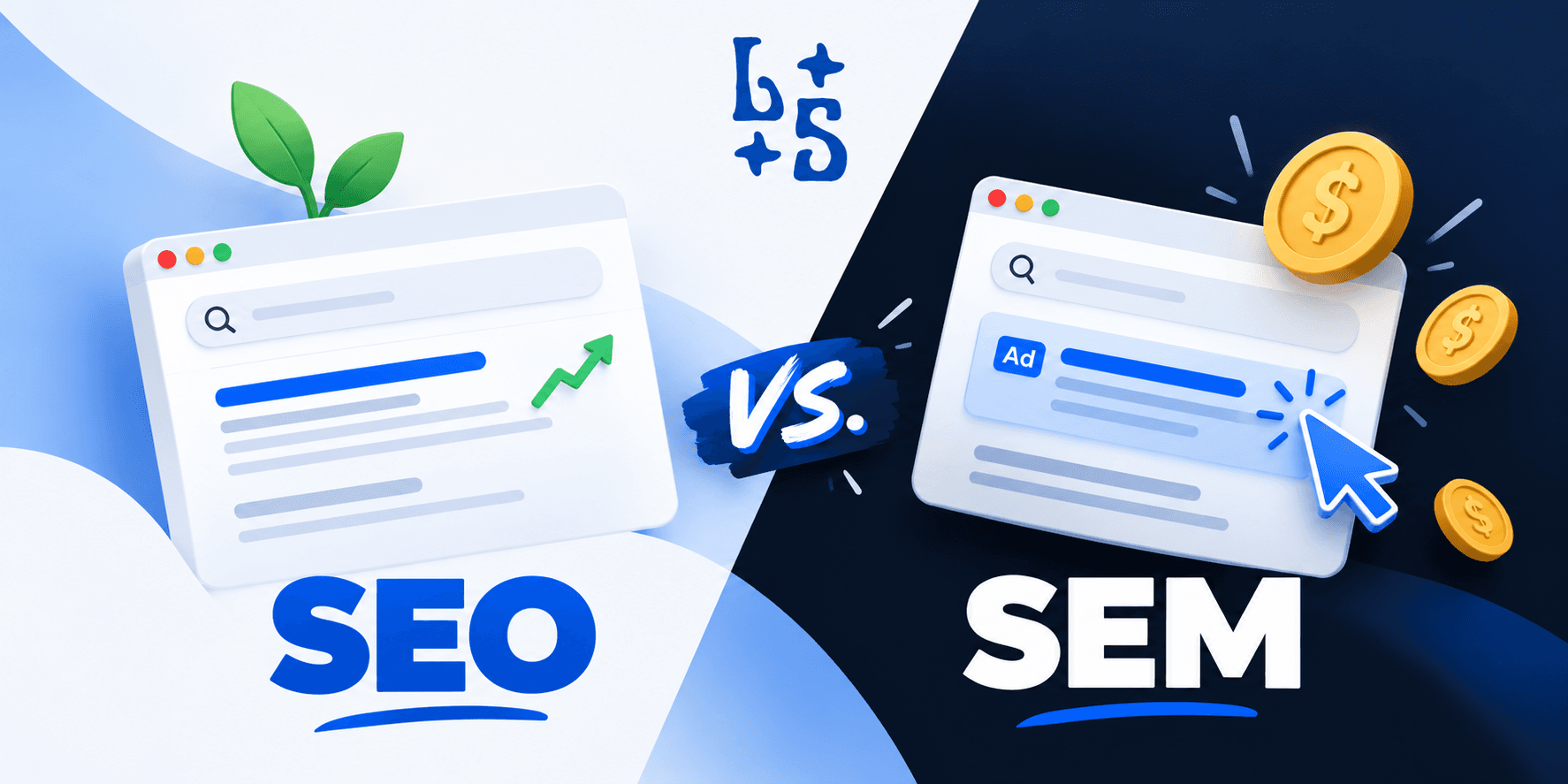
SEO vs. SEM: Differences in Tactics, Costs, and Results
The Invisible Storefront — Why Great Businesses Fail on Google
Imagine you own the absolute best restaurant in town. The food is incredible, the tables are set perfectly, and the staff is waiting. But there is one massive problem: your restaurant is hidden in an alleyway, and no one can find the front door.
This exact scenario happens to thousands of businesses online every single day. They build a beautiful website, but they are completely invisible on Google. To fix this, you have two main choices: pay Google for immediate attention, or build long-term trust to earn free visitors. Choosing the wrong path can drain your budget in a matter of weeks.
So, what is the exact difference between SEO and SEM, and which one will actually bring customers to your virtual front door? Let's break it down in simple terms so you never waste a dollar on the wrong strategy.
Choosing the wrong path can drain your budget in a matter of weeks.
SEO vs. SEM — What’s the Core Difference?
When a user searches for something on Google, they are taken to a Search Engine Results Page (SERP). This page is divided into two main sections: paid ads and free results.
In the simplest terms, SEO vs SEM comes down to how you get your website onto that page:
- SEO (Search Engine Optimization): This is how you earn free traffic. You optimize your website so Google naturally wants to show it to people. It takes time, just like growing a garden.
- SEM (Search Engine Marketing): This is how you pay for traffic. You buy ads that appear at the very top of Google. It is instant, like turning on a light switch. But be careful—the light goes out the second you stop paying.

What Is SEO? (The Free Traffic Engine)
SEO is all about proving to Google that your website is the best, most helpful answer to a user's question. Think of Google as a giant library, and SEO is how you convince the librarian to recommend your book first.
To win at SEO marketing, you need to focus on four main pillars:
Keyword Research
You need to know exactly what words people type into Google. Are your customers searching for "cheap shoes" or "buy red running shoes near me"? Finding the right keywords is the foundation of your entire strategy. If you answer the questions people are actually asking, Google will reward you.

On-Page SEO
This is about making your web pages easy for Google to read. It means putting your chosen keywords in the right places—like your titles, headers, and image names. More importantly, it means writing content that actually helps the reader solve their problem.
Off-Page SEO
Think of this as a popularity contest. If other trusted websites link to yours, Google sees that as a "vote of confidence." For example, imagine a popular local restaurant like Roots in Logroño. If a famous Spanish food blogger links to their website, Google thinks, "Wow, Roots must be a great place!" and moves their website higher in the search results.

Technical SEO
This is the behind-the-scenes work. Your website needs to load fast, look perfect on mobile phones, and have no broken links. If your site takes 10 seconds to load, visitors will get frustrated and leave. When Google sees people leaving quickly, they will drop your ranking.
What Is SEM? (The Paid Fast Track)
While SEO is about earning your spot, what is SEM? It is about buying your spot. When you search for something on Google, the first few results usually have the word "Sponsored" or "Ad" in bold text next to them. That is Search Engine Marketing (also known as Pay-Per-Click or PPC).
It's instant, like turning on a light switch — but the light goes out the second you stop paying.
Bidding & Budgets
SEM works like an auction. You tell Google, "I am willing to pay $2 every time someone clicks on my ad." You bid against other businesses who want the same keywords. The business with the best combination of a high bid and a high-quality ad gets the top spot.

Audience Targeting
SEM allows you to be incredibly precise. With SEO, anyone can find you. With SEM, you can tell Google to only show your ads to people who live within a 10-mile radius, use an iPhone, and are searching on a Tuesday afternoon.
Ad Creation & Assets
Because you are paying for space, your ads need to be highly clickable. You have to write catchy headlines and descriptions that make people want to click your link instead of scrolling down to the free SEO results.

SEO vs. SEM — How Much Do They Cost?
This is the most common question business owners ask. Neither strategy is truly "free," but they cost money in very different ways.
The Cost of SEO
You pay with time, strategy, and effort. You will likely pay an expert to write great content, fix your website's code, or build links. However, once you rank high, you do not pay Google a single cent when a user clicks your link. The clicks are free forever, as long as you maintain your ranking.
The Cost of SEM
You pay for every single click. If 100 people click your ad and your cost-per-click is $3, you pay Google $300. It is predictable, but it is a permanent expense.
SEO vs. SEM — How Long Does It Take to See Results?
This is the biggest difference between SEO and SEM, and it is where most businesses make their mistakes.
- SEM is instant. You can create a Google Ads account today, put in your credit card, write an ad, and be at the top of Google in less than two hours. It is the fastest way to get traffic.
- SEO takes patience. It usually takes 3 to 6 months to start seeing real momentum. Google needs time to crawl your site, analyze your content, and trust you enough to push you up the ranks. It is a slow start, but a massive long-term reward.
SEO vs. SEM — Which Practice Is Right for You?
You do not always have to choose just one, but here is a simple rule of thumb for businesses:
Use SEM if
- You have a brand-new website and need visitors today.
- You are running a short-term holiday sale or promotion.
- You need to generate leads this exact week to keep your business running.
Use SEO if
- You want to build long-term, sustainable brand authority.
- You want to stop relying purely on paid ads to survive.
- You want to dominate your local market for years to come.
Frequently asked questions
Can I do SEO without SEM?
Yes, absolutely. Many highly successful websites rely 100% on SEO for their traffic. It just takes more time to build momentum at the beginning.
Does running SEM ads help my SEO rankings?
No. Google has stated many times that buying ads does not magically boost your organic (free) SEO rankings. They are separate systems. However, the data you get from SEM (like knowing exactly which keywords turn into sales) can help you write much better SEO content.
Which one has a better Return on Investment (ROI)?
In the short term, SEM can have a great ROI because it targets users who are ready to buy right now. But in the long run, SEO almost always provides the best ROI because the traffic continues to flow even if you reduce your marketing budget.
Want help putting this into practice?
Get your free consultation